K-State got its start in 1858 when Bluemont Central College was founded and 53 students enrolled. Five years later K-State became the first fully operational land-grant college in America. Kansas State University is 150 years old and is recognized by the Princeton Review as one of America's best colleges. The Graduate School offers 65 master's degrees, 45 doctoral degrees and 22 graduate certificates in multiple disciplines across campus. More than 23,800 from all 50 states and more than 90 countries. More than 250 undergraduate majors and options are available.
This is Willard Hall, the art block.
This building includes painting, drawing, photography, metal smithing,
jewellery, ceramics, sculpture, printmaking and mixed media studios. We are on
the top floor and have 3 rooms just for metals!
 |
| Willard Hall |
 |
| Willard Hall |
We have keys and access to the studios
and equipment 24 hours a day, 7 days a week. This is such a huge benefit, with
keeping up with deadlines. We also have our own spaces, so when there are
classes in the other rooms, we always have our own desk with our own basic but
essential tools. Here is the entrance to our studio.
In the first and main room, it has tools, a heat gun area, numerous pickles, sinks, doorways to two other rooms, tools, computer with scanner/printer, casting area, and spaces; every desk has 4 spaces, a 'Sharp
objects' bucket, a few sandpaper tiles, and a sink, which has numerous
scourers, cleaning alcohol, and other cleaning tools. Every space has a light,
2 different types of bench pegs, 2 clamps, wax for blades, saw and a pair of
glasses.
 |
| Room 1 |
 |
| Individual Spaces |
Here are some of the numerous tools such
as hammers, doming blocks, ring mandrels, hand drills, centre punches and lots
of useful things that I didn't even know existed!
 |
| 3 tool cupboards |
At the end of the heat gun area, there
is a sink and a 'Super Pickle' (yes, this really is what it's called).
 |
| Heat gun area |
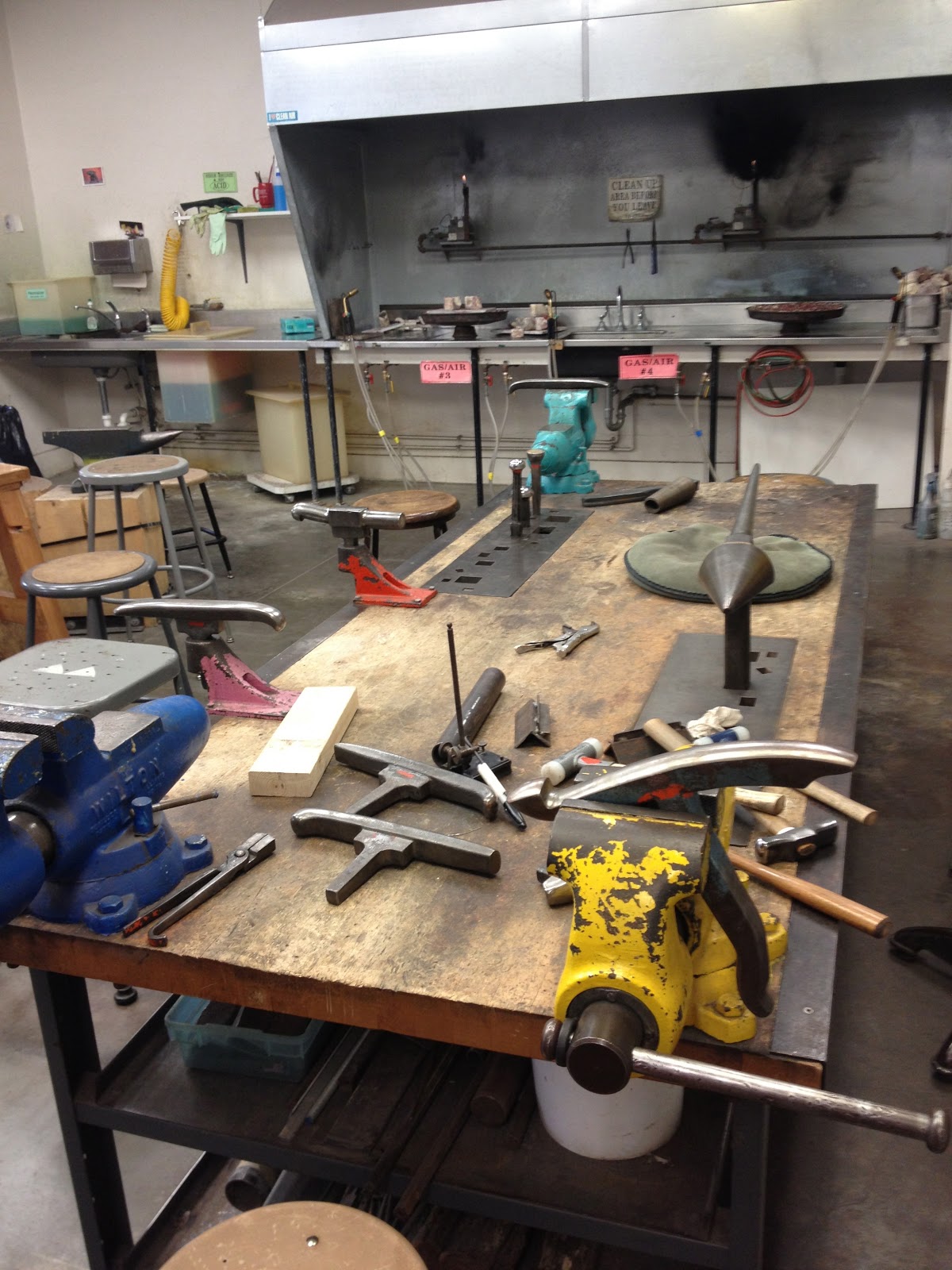
This is the room where hammering
and forging happens. There are also 4 extra heat guns, (13 in total of the
whole metals studio). Also in this room, there are plenty of lockers for
students to use. To the left of this picture, you can see there is a sink, and
a huge pickle tub for larger pieces. There are 4 anvils to work on, also two
tables with adjustable mushroom steaks on. In this room there are two sinks.
 |
| Room 2 |
 |
| Lockers |
 |
| Hammer table |
 |
| Anvils & hammering tables |
 |
| Forging Mill |
 |
| Rolling Mill |
 |
| Hammer and steaks cupboard |
In between this room, and the next room, is an area for polishing, there are 4 polishing booths, 2 with adjustable parts, and 2 polishing areas, that actually have 2 wheels each; three for silver and one for copper, there is also a bronze buffer available in a different room.
 |
| Polishing area |
 |
| Various polishing tools |
 |
Polishing wheels
|
 |
| Bronze buffer |
 |
| Bronze buffer |
In the third room there are individual spaces for the major students, the metal cupboards and some extra tools.
 |
| Major student spaces |
 |
| Metal cutter |
 |
| Sand blaster |
 |
| Sarah and mine's shared space |